 Booklet Imposer
Booklet Printing Guide
Last updated:
What this guide covers
This guide is about the physical side of a booklet: the paper you print on, how to fold it cleanly, and how to staple it so it holds together. It assumes you already have an imposed PDF from the PDF booklet maker. For printer dialog settings, read how to print a booklet; for the duplex flip setting, see printing a booklet double-sided.
Choosing paper
Ordinary 80–100 gsm (20–27 lb) office paper folds cleanly and is the easiest place to start. Heavier paper looks nicer but gets harder to fold and staple as the booklet grows, and it makes creep more noticeable. A heavier sheet (around 160 gsm) can work as the outer cover sheet if your stapler still closes through the whole stack.
Paper size follows the page size you want. Two A5 pages fit side by side on A4, and two half-letter pages (5.5 × 8.5 in) fit on US Letter. If your PDF pages are already A4 or Letter, the tool can scale them down to fit, or you can use larger paper if your printer takes it.
Grain direction
Paper has a grain, the direction most of its fibers run. A fold along the grain is smooth; a fold across it can crack, especially on heavier or coated stock. Ideally the grain runs parallel to the spine. Office paper is often “long grain”, which, for a landscape booklet sheet, runs across the fold, so thin office paper usually folds fine anyway. If a heavier stock cracks, try a sheet cut the other way or score the fold first.
Folding cleanly
Keep the sheets in the order they came out of the printer and fold them all together, as one stack. Folding each sheet separately and nesting them afterward makes the spine bulky and the edges uneven. Line up the top edges (the “head”) by tapping the stack on the table, fold in half, and press along the fold with a bone folder, the back of a spoon, or a ruler.
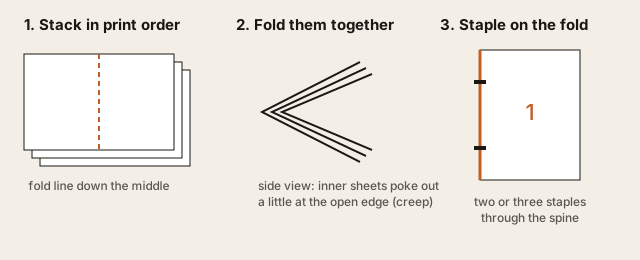
Turning on the fold line in the tool’s export options prints a faint guide line on the inside, which helps with the first few booklets.
Stapling
Staple through the fold from the outside, so the closed ends of the staples sit on the inside of the center spread. Two staples are enough for an A5 or half-letter booklet; use three for taller booklets. Place them a little in from the head and foot.
A normal stapler can’t reach the middle of an opened sheet. A long-reach stapler is the simplest option. Without one, open the booklet over a piece of corrugated cardboard or a folded towel, push an ordinary stapler open flat, staple through into the cardboard, and bend the staple legs closed by hand.
Trimming (optional)
Most home booklets are not trimmed at all. If your design has bleed, or the inner sheets poke out at the open edge on a thicker booklet, you can trim the fore-edge with a guillotine or a sharp knife and a metal ruler. If you plan to trim, set bleed and crop marks in the tool before exporting, and read gutter vs creep so the margins still look even after cutting.